

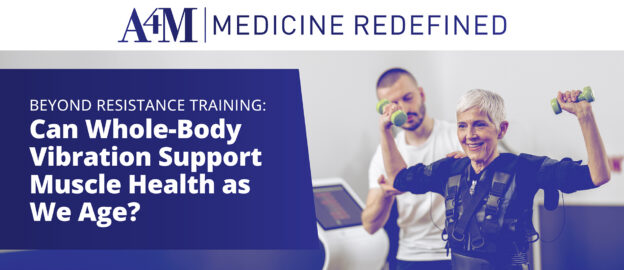
When it comes to healthy aging, physical activity is crucial. The U.S. Centers for Disease Control and Prevention (CDC) reports that adults with at least one chronic disease were less active than adults reporting no chronic disease. The CDC also reports that only about one in seven adults aged 65+ meet both aerobic and muscle-strengthening exercise targets, and that nearly 30% of adults 50+ are physically inactive. But physical activity may be particularly difficult for aging adults, especially those with sarcopenia, a syndrome characterized by progressive loss of muscle mass, strength, and physical performance. Current research is looking at whether people who are unable to exercise can use vibration and electrical stimulation to support muscle health when age-fighting activities like resistance training are no longer an option.
WBVT and Aging
Hormonal changes, decreased neuroregulation, and muscle mass loss are among the main physical changes that human aging brings. Sarcopenia, the loss of muscle mass and strength with aging, results in muscle weakness and decreased strength production, both of which reduce functional activity as we age, limiting daily activity, increasing the risk of falls and fractures, and reducing quality of life.
To improve muscle function in older adults, various forms of strength training – lifting free weights, using resistance bands or body weight for resistance, or using weight machines – are recommended, as well as easy and safe exercises like squats, lunges, or shoulder presses. When conventional exercises are difficult to perform because sarcopenia has deteriorated physical capacity, physical therapists may suggest whole-body vibration training (WBVT) as an alternative way of improving neuromuscular function, as well as electrical muscle stimulation (EMS).
The latter uses low-level electrical impulses delivered through skin-placed electrodes to trigger involuntary muscle contractions and is commonly used in physical therapy, rehabilitation, and fitness training.
WBVT involves standing on a vibrating platform either at home or at a rehabilitation center, and research suggests it may have positive effects on strength, balance, functional mobility, and quality of life in older adults. WBVT has also been studied in fields such as stroke and cerebral palsy rehabilitation, musculoskeletal pain, and blood sugar control in diabetic patients. A recent experimental study demonstrated that WBVT improved the physical ability of older adults with sarcopenia, but there is insufficient research or evidence on how much WBVT can enhance the effects of resistance exercise compared with conventional resistance exercise following stretching exercise, and the effect on quality of life after WBVT is still unclear. New research, however, is taking a closer look.
Sarcopenia and Conditioning
A study at the Centre of Active Ageing Project in the Interreg Slovakia-Austria cross-border cooperation program found that RT and WBV are effective for increasing muscle strength, while the data were very limited for EMS. Further studies exploring the effect of WBV, and in particular EMS, the study concluded, are needed for better comparison with RT.
According to a study on 40 participants at the Korea Centers for Disease Control and Prevention, lower-extremity muscle strength improved significantly in both the WBVT (WBVT + strengthening) and control (stretching + strengthening) groups, while physical performance improved only in the WBVT group after training. The study noted that WBVT can be safely performed by older adults and may be an alternative exercise method to boost the effect of strengthening exercise.
Another study, approved by the Ethical Committee of Chongming Hospital Affiliated with Shanghai Medical College of Health Sciences, was a 12-week, assessor-blinded randomized controlled trial investigating the efficacy of WBVT and RT in terms of body composition, muscle strength, physical performance, blood biomarkers, and quality of life.
Three hundred fifty-three older people were recruited and screened, with 27 ultimately meeting the eligibility criteria and randomized into the WBVT (n=14) and RT (n=13) groups. No subjects dropped out during the 12-week intervention. WBVT and RT showed similar effectiveness in improving the physical condition of older people with sarcopenia. Although RT had an advantage in enhancing muscle strength, WBVT provided a feasible alternative for subjects who were restricted or unsuitable for RT. The study also showed that, in clinical practice, WBVT was suitable for various physical conditions due to its feasibility and flexibility. Introducing WBVT improved muscle strength and enhanced physical function, and ultimately, this study provided a new option for rehabilitation training in sarcopenia, emphasizing the importance of WBVT.
Concluding Thoughts
For aging adults, especially those with sarcopenia, healthspan-boosting exercise may be difficult to achieve. RT remains the most robust intervention for preserving and improving muscle strength and functional performance in older adults, but it can be supplemented by WBVT and EMS when necessary. Preliminary studies have shown that WBVT can improve muscle strength and enhance physical function for those unable to perform heavy resistance exercise, but it should be tailored to individual capacity and monitored for safety. Studies also show that fully understanding the benefits of EMS requires further research. The fact that physical activity is a critical aspect of healthy aging remains undisputed; discovering ways to make physical activity more accessible is just one of the objectives of longevity science.
Sources:

Effectiveness of Whole-Body Vibration Training to Improve Muscle Strength and Physical Performance in Older Adults: Prospective, Single-Blinded, Randomized Controlled Trial

Resistance Exercise, Electrical Muscle Stimulation, and Whole-Body Vibration in Older Adults: Systematic Review and Meta-Analysis of Randomized Controlled Trials

Effects of 12-week whole-body vibration training versus resistance training in older people with sarcopenia